
In today’s digital economy, an organisation’s domain name, email system, website, and cloud services are among its most valuable business assets. Yet many businesses unknowingly hand control of these assets to third-party administrators during setup. While this arrangement may seem convenient at first, it often creates long-term dependency, operational risks, and unnecessary barriers to growth.
The Hidden Problem
Some third-party domain administrators register and manage multiple client domains, DNS records, websites, and email systems under accounts the clients do not own or control. In many cases, organisations are not given direct access to the platforms where their digital assets are managed. As a result, they become dependent on a service provider for even the simplest changes.
The risk becomes apparent when the organisation wants to:
- Change service providers
- Migrate email platforms
- Transfer domain ownership
- Modify DNS configurations
- Integrate new technologies
- Scale its digital operations
What should be a straightforward business decision can quickly turn into a complicated process involving delays, restrictions, additional fees, or disputes over access and ownership.
Digital Independence is Not Optional
Every organisation is a distinct legal and operational entity. As such, it should maintain full ownership and administrative control of its digital infrastructure.
Digital independence means that:
- The organisation owns its domain registrations.
- Administrative accounts belong to the organisation.
- Access can be transferred without disruption.
- Technology decisions remain with the business.
- Service providers can be changed freely when necessary.
Independent ownership does not eliminate the need for service providers. Instead, it creates a healthier relationship where providers compete on value, expertise, support, and innovation rather than dependency.
The Cost of Vendor Lock-In
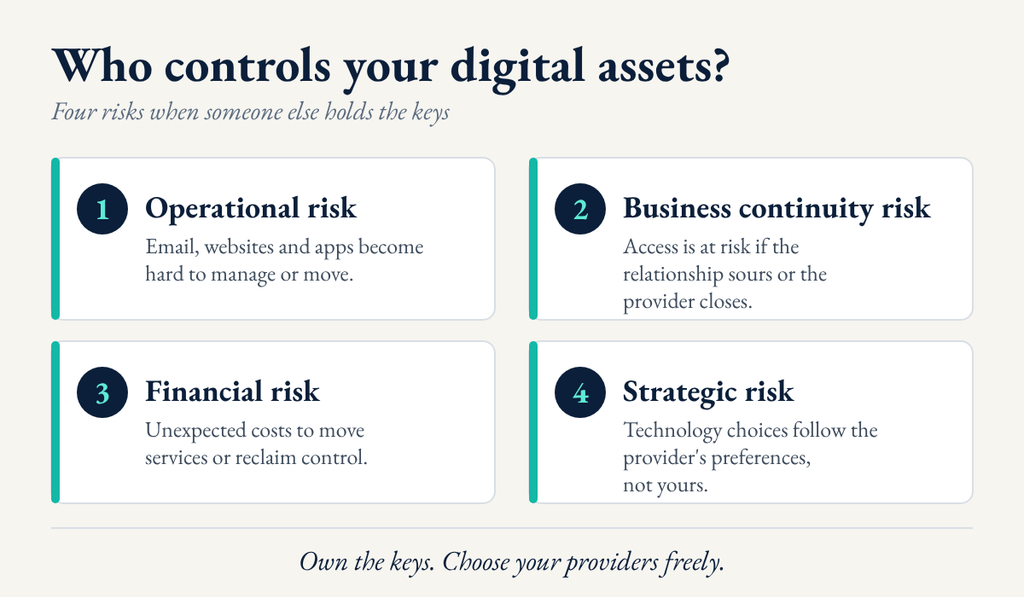
When critical digital assets are controlled by a third party, businesses face several risks:
Operational Risk – Essential services such as email, websites, and online applications may become difficult to manage or migrate.
Business Continuity Risk – Access to critical systems can be affected if the relationship with the provider deteriorates or if the provider ceases operations.
Financial Risk – Organisations may face unexpected costs when moving services or reclaiming administrative control.
Strategic Risk – Technology decisions become constrained by a provider’s preferences rather than the organization’s business objectives.
These risks are often avoidable when digital infrastructure is set up correctly from the start.
What Responsible Service Providers Should Do
Professional technology partners should design solutions that promote transparency and client ownership.
Best practice includes:
- Registering domains in the client’s name.
- Creating separate administrative accounts for each organisation.
- Granting appropriate access to authorised business representatives.
- Documenting ownership and recovery procedures.
- Supporting migrations when requested.
- Avoiding technical configurations designed to create dependency.
- Strong business relationships are built on trust, not restrictions.
A Better Model
Organisations should view digital infrastructure in the same way they view their bank accounts, legal documents, or intellectual property. While trusted service providers may manage these assets on the organisation’s behalf, ownership should always remain with the business. Technology partners who respect this principle create stronger, longer-lasting customer relationships because clients stay by choice, not because they are locked in.
Final Thoughts
Digital transformation is not only about adopting new technologies. It is also about ensuring that organisations retain control over the systems that power their operations. Business leaders should regularly review ownership of their domains, email systems, cloud subscriptions, websites, and administrative accounts to ensure they maintain independent control. Digital infrastructure independence is more than a technical best practice. It is a matter of governance, business continuity, and organisational freedom. Every organisation deserves the right to own, control, and freely manage its digital future.
#SayNoToTechnicalLockIn